There is a specter haunting the creative industry. It is not the specter of "The Machine." It is the specter of Grief.
If you scroll through the timelines of designers, photographers, and artists today, you don't just see technical critique of AI; you see moral outrage. You see anger. You see a fierce defense of "The Human Element."
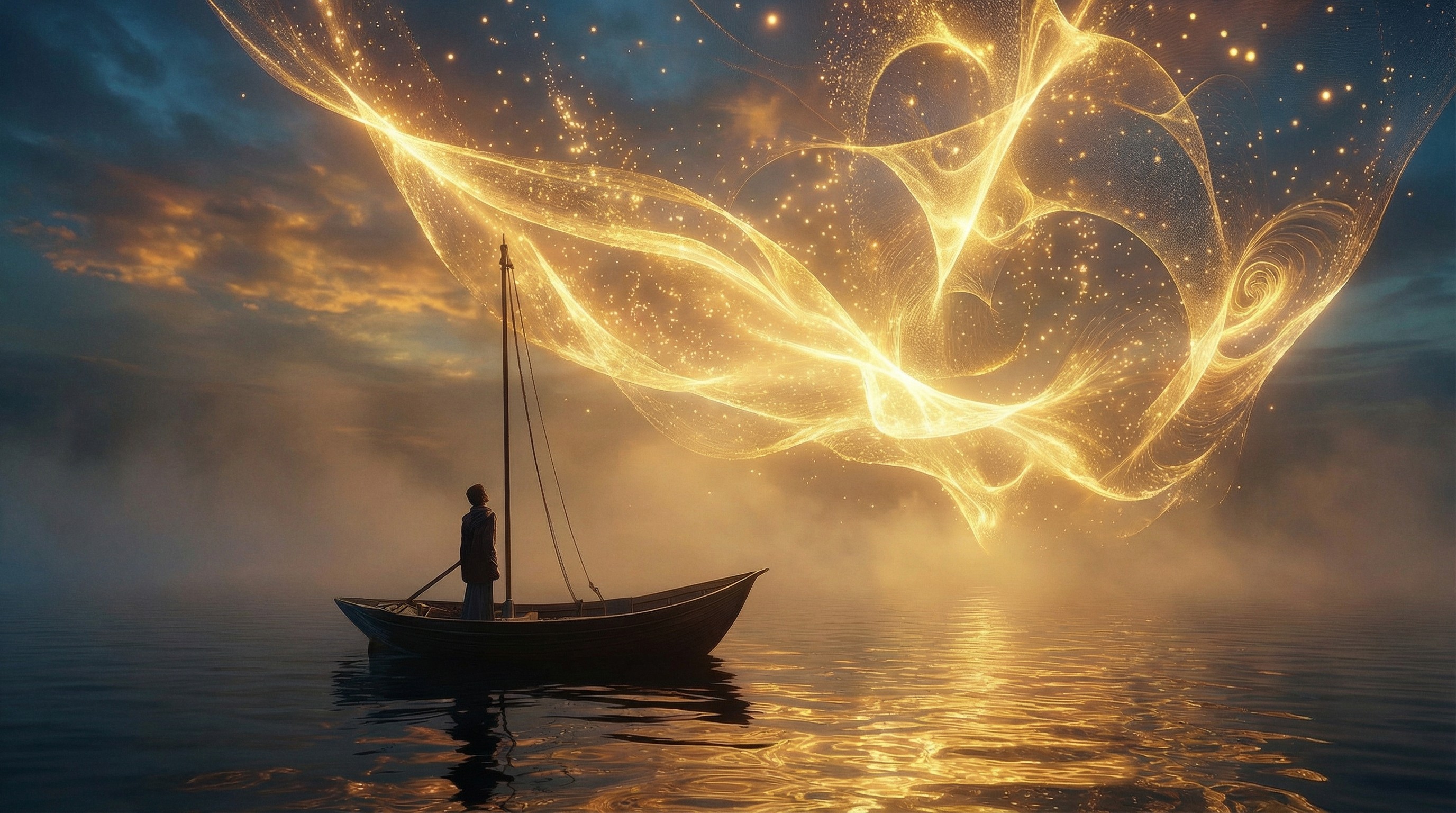
But if you listen closely to the frequency of that anger, it sounds exactly like a man screaming at an approaching boat in the fog, only to realize—too late—that the boat is empty.
At Ford Media Lab, we believe the industry is currently trapped in a "Crisis of Meaning." For centuries, we have been conditioned to believe that Value = Struggle. We operate on the assumption that if we didn't sweat for the image, if we didn't spend 12 hours retouching the skin, if we didn't hike the mountain at 4 AM, the art is "cheating."
We are addicted to the struggle. And AI has just removed the struggle.
This isn't a technology update. It is a reality update. And to survive it, you don't need a new plugin; you need a Psychological Recalibration.
Here is the map.
I. The "Empty Boat" Reality
The first step in the recalibration is to stop treating AI as an "Opponent." There is no "Enemy" trying to steal your job. There is simply a rising tide of efficiency. To scream at the tide is to argue with physics.
Walter Benjamin, in his 1935 essay The Work of Art in the Age of Mechanical Reproduction, presciently wrote that mechanical reproduction "emancipates the work of art from its parasitical dependence on ritual." For decades, the commercial art world has relied on the Ritual of Labor—the belief that sweat equals value. AI is the final severance of that tie. It is not the death of art; it is the liberation of the image from the tyranny of the technical.
The "Anti-AI" creative is stuck in a loop of Resistance: "This shouldn't be happening." The "Lucid" creative moves into a state of Flow: "This is happening. How do I surf it?"
We must detach our ego from the "Hard Work." We must realize that "Hard Work" was never the goal; Impact was the goal. If you can achieve the same impact with 1% of the caloric burn, you haven't "cheated"; you have evolved. You have moved from rowing the boat to hoisting a sail.
II. From "The Judge" to "The Scientist"
Marshall McLuhan taught us that every new technology creates an "amputation" alongside an "extension." The car extended the foot but atrophied the leg. AI is extending our Imagination to god-like proportions, but it is amputating our Execution. The anxiety many feel today is simply the "phantom limb" pain of manual craft.
To heal this, we must shift from the Judge to the Scientist.
The biggest trap for the modern creative is the Judgment Reflex. When AI produces something weird—a hand with six fingers, a hallucinated texture—the traditionalist sneers. "See? It's trash. It has no soul." But this denies the history of our own industry. We are simply witnessing the industrialization of Marcel Duchamp’s "Readymade."
When Duchamp signed a urinal and called it art in 1917, he proved that choice is a creative act. He proved that the artist’s hand is less important than the artist’s mind. The AI prompter is the ultimate conceptual artist. We do not paint the pixels; we select the probability. To deny the validity of the "Prompt" is to deny the last century of art history.
The Recalibrated Mindset stops judging the tool and starts studying the output. We treat the glitch not as a failure, but as a "Cabinet of Curiosities." Fascination is the antidote to Fear.
III. The "Leela" Protocol (Creativity as Play)
We are exiting the age of Creativity as War (conquering the blank page) and entering the age of Creativity as Play.
In ancient philosophy, the concept of Leela describes the universe as a "Divine Game." The goal isn't to win; the goal is to keep playing. For too long, agency life has been a war of attrition. Deadlines, budgets, burnout. AI offers us a chance to return to Leela.
By outsourcing the heavy lifting of "rendering" to the GPU, we are free to return to the playground of "ideation." We can try 100 bad ideas in 10 minutes without penalty. We can explore the "multiverse" of a brand's identity without the cost of a photoshoot.
The "Anti-AI" creative is protecting their right to suffer. The "Recalibrated" creative is claiming their right to play.
IV. The Rise of the "Psychohistorian"
If we aren't the "Makers" anymore, what are we? We are the Architects of Desire.
Borrowing from Asimov’s Foundation, the new creative director is a "Psychohistorian." We are no longer mechanics of light; we are engineers of feeling. Since the AI handles the "How" (the physics), we are solely responsible for the "Why" (the psychology).
When the AI hallucinates, it is not "glitching" in the traditional sense. It is dipping into the Collective Unconscious. These models are trained on the sum total of human imagery—our fears, our myths, our biases. When we prompt the machine, we are not coding; we are interpreting a digital dream. As Carl Jung said, "Who looks outside, dreams; who looks inside, awakes."
The Lucid Creative looks into the model to wake up to what humanity is actually dreaming. Our job is to filter those dreams into images that bypass the viewer's logic and hit their dopamine centers directly. We are moving from Visual Fidelity (looking real) to Emotional Resonance (feeling true).
The Wake-Up Call
The future belongs to the Lucid Creative.
The Lucid Creative is the one who realizes they are in a simulation and decides to stop fighting the code and start rewriting it.
Stop mourning the death of the "Struggle." The boat is empty. The wind is picking up. Hoist the sail.
There is a specter haunting the creative industry. It is not the specter of "The Machine." It is the specter of Grief.
If you scroll through the timelines of designers, photographers, and artists today, you don't just see technical critique of AI; you see moral outrage. You see anger. You see a fierce defense of "The Human Element."
But if you listen closely to the frequency of that anger, it sounds exactly like a man screaming at an approaching boat in the fog, only to realize—too late—that the boat is empty.
At Ford Media Lab, we believe the industry is currently trapped in a "Crisis of Meaning." For centuries, we have been conditioned to believe that Value = Struggle. We operate on the assumption that if we didn't sweat for the image, if we didn't spend 12 hours retouching the skin, if we didn't hike the mountain at 4 AM, the art is "cheating."
We are addicted to the struggle. And AI has just removed the struggle.
This isn't a technology update. It is a reality update. And to survive it, you don't need a new plugin; you need a Psychological Recalibration.
Here is the map.
I. The "Empty Boat" Reality
The first step in the recalibration is to stop treating AI as an "Opponent." There is no "Enemy" trying to steal your job. There is simply a rising tide of efficiency. To scream at the tide is to argue with physics.
Walter Benjamin, in his 1935 essay The Work of Art in the Age of Mechanical Reproduction, presciently wrote that mechanical reproduction "emancipates the work of art from its parasitical dependence on ritual." For decades, the commercial art world has relied on the Ritual of Labor—the belief that sweat equals value. AI is the final severance of that tie. It is not the death of art; it is the liberation of the image from the tyranny of the technical.
The "Anti-AI" creative is stuck in a loop of Resistance: "This shouldn't be happening." The "Lucid" creative moves into a state of Flow: "This is happening. How do I surf it?"
We must detach our ego from the "Hard Work." We must realize that "Hard Work" was never the goal; Impact was the goal. If you can achieve the same impact with 1% of the caloric burn, you haven't "cheated"; you have evolved. You have moved from rowing the boat to hoisting a sail.
II. From "The Judge" to "The Scientist"
Marshall McLuhan taught us that every new technology creates an "amputation" alongside an "extension." The car extended the foot but atrophied the leg. AI is extending our Imagination to god-like proportions, but it is amputating our Execution. The anxiety many feel today is simply the "phantom limb" pain of manual craft.
To heal this, we must shift from the Judge to the Scientist.
The biggest trap for the modern creative is the Judgment Reflex. When AI produces something weird—a hand with six fingers, a hallucinated texture—the traditionalist sneers. "See? It's trash. It has no soul." But this denies the history of our own industry. We are simply witnessing the industrialization of Marcel Duchamp’s "Readymade."
When Duchamp signed a urinal and called it art in 1917, he proved that choice is a creative act. He proved that the artist’s hand is less important than the artist’s mind. The AI prompter is the ultimate conceptual artist. We do not paint the pixels; we select the probability. To deny the validity of the "Prompt" is to deny the last century of art history.
The Recalibrated Mindset stops judging the tool and starts studying the output. We treat the glitch not as a failure, but as a "Cabinet of Curiosities." Fascination is the antidote to Fear.
III. The "Leela" Protocol (Creativity as Play)
We are exiting the age of Creativity as War (conquering the blank page) and entering the age of Creativity as Play.
In ancient philosophy, the concept of Leela describes the universe as a "Divine Game." The goal isn't to win; the goal is to keep playing. For too long, agency life has been a war of attrition. Deadlines, budgets, burnout. AI offers us a chance to return to Leela.
By outsourcing the heavy lifting of "rendering" to the GPU, we are free to return to the playground of "ideation." We can try 100 bad ideas in 10 minutes without penalty. We can explore the "multiverse" of a brand's identity without the cost of a photoshoot.
The "Anti-AI" creative is protecting their right to suffer. The "Recalibrated" creative is claiming their right to play.
IV. The Rise of the "Psychohistorian"
If we aren't the "Makers" anymore, what are we? We are the Architects of Desire.
Borrowing from Asimov’s Foundation, the new creative director is a "Psychohistorian." We are no longer mechanics of light; we are engineers of feeling. Since the AI handles the "How" (the physics), we are solely responsible for the "Why" (the psychology).
When the AI hallucinates, it is not "glitching" in the traditional sense. It is dipping into the Collective Unconscious. These models are trained on the sum total of human imagery—our fears, our myths, our biases. When we prompt the machine, we are not coding; we are interpreting a digital dream. As Carl Jung said, "Who looks outside, dreams; who looks inside, awakes."
The Lucid Creative looks into the model to wake up to what humanity is actually dreaming. Our job is to filter those dreams into images that bypass the viewer's logic and hit their dopamine centers directly. We are moving from Visual Fidelity (looking real) to Emotional Resonance (feeling true).
The Wake-Up Call
The future belongs to the Lucid Creative.
The Lucid Creative is the one who realizes they are in a simulation and decides to stop fighting the code and start rewriting it.
Stop mourning the death of the "Struggle." The boat is empty. The wind is picking up. Hoist the sail.