Fast is not the same as cheap
tl;dr
Why hybrid production delivers full studio quality on a fraction of the timeline, and why the speed is a delivery mechanism, not a discount. For spirits brands and agencies who need the work fast without compromising it.

TL;DR: Hybrid production lets us deliver high-end commercial photography faster than a traditional shoot. The speed is real. The discount is not. The shoot day shrinks, but the work moves to pre-production and the workstation, and running that well takes more discipline, not less. The method flexes across a spectrum, from in-studio capture to fully generated scenes, but the standard never moves. This is for brands and agencies who need the quality and cannot wait for the calendar.
A client came to us at the end of April with a Cinco de Mayo campaign and seventy-two hours. Sixteen hero images, three signature cocktails, a full activation. A traditional location shoot of that scope does not fit in three days. We delivered it in three days, and it shipped straight into earned media.
Here is the part that matters. We charged what we would have charged for a traditional production. The client, who had hired us for traditional shoots before, paid it without blinking, because they knew what the work was worth and they knew we were the ones who could land it on that timeline. That is the entire proposition. Not cheaper. Faster, at the same standard. Those are different things, and the difference is the whole point.
What is the hybrid method, actually?
It is not one technique. It is a spectrum, and we choose where to sit on it per frame, based on what the shot needs.
At one end is in-studio capture. We shoot the real product, the real liquid, the real bottle, on medium-format, the same way we always have. At the other end is neural rendering, where an environment is generated rather than built or found. In between sits everything that makes the method powerful: composited capture, where real studio photography is placed into a constructed scene; built environments rendered to brief instead of scouted and rented; generated backgrounds that would be impossible, uneconomic, or simply too slow to produce any other way.
A single campaign might use all of it. The bottle and the pour are real, shot on a table in our studio. The rooftop behind them is generated. The bar they sit on is built. The light is matched across every layer so the seams disappear. What lands in front of the client reads as one photograph taken in one place at one time. It was assembled from wherever each element was best made.
The dial moves toward traditional capture when the product and its handling have to be flawless and tactile. It moves toward neural rendering when the world around the product is the variable and building it for real would cost a week and a location budget. Most jobs live in the middle. The blend is a creative decision, not a default.
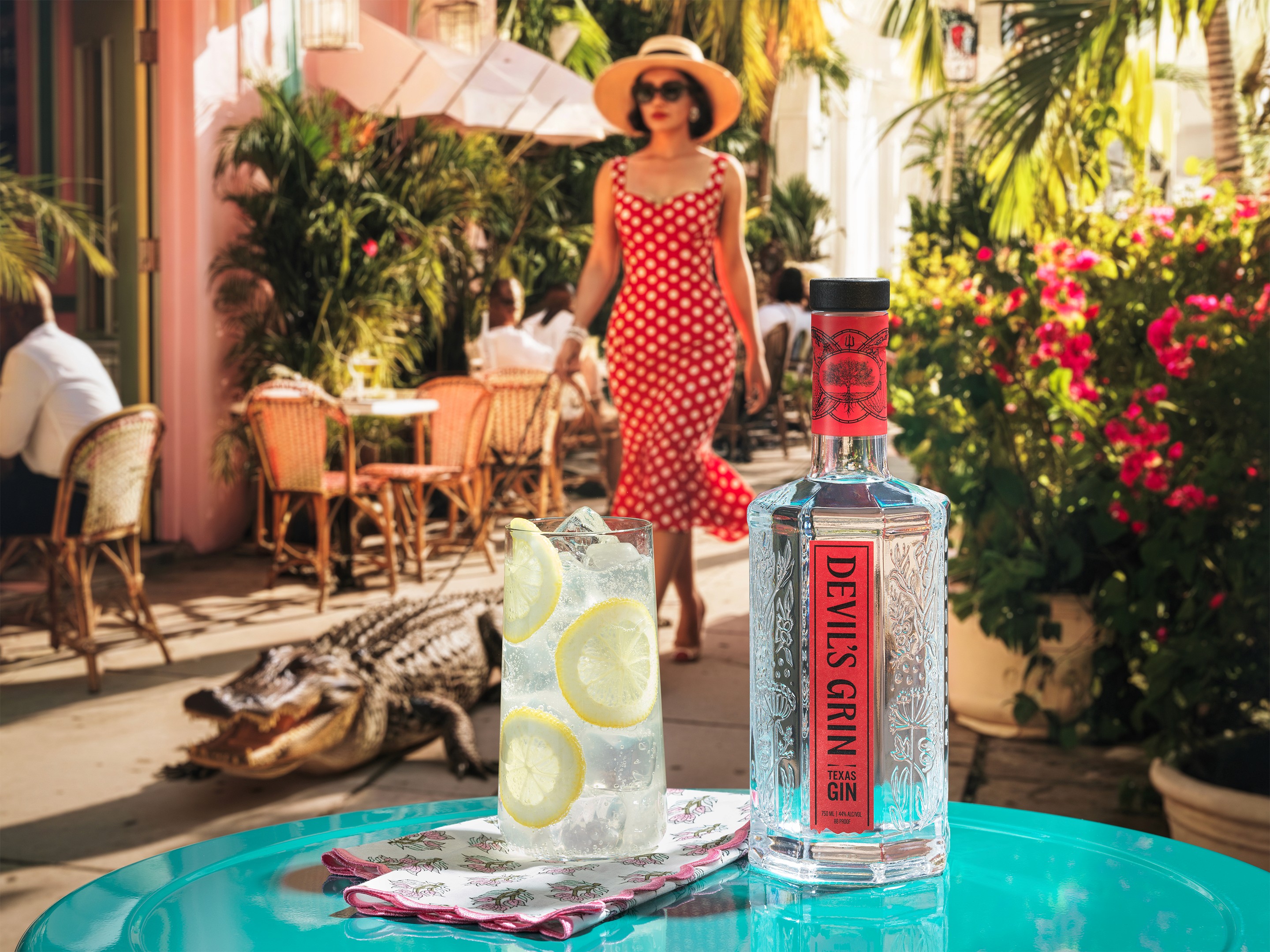
Then why does it all look like a studio shoot?
Because the people making it spent ten years shooting studio product photography before any of this existed.
This is the part that does not transfer and cannot be skipped. The reason our hybrid work looks like high-end commercial photography, regardless of how any individual frame was produced, is that we know what high-end commercial photography looks like in our hands. We know how light wraps a bottle. We know where the highlight on the glass has to fall. We know the difference between a composite that reads as real and one that reads as a collage, and we know it because we spent a decade making the real version.
The tools changed. The eye did not. Strip the expertise out and the method produces exactly the fast, cheap, vision-less imagery flooding the category right now, the stuff that makes a brand look like it cut a corner. The method is not the advantage. The judgment operating the method is the advantage. That is why two studios using the same tools do not produce the same work, and it is why the result, not the technique, is what we sell.
Is this just a cheaper way to make pictures?
No. The work did not get smaller. It moved.
The shoot day mostly disappears. In our typical engagement, the only capture is the product and the cocktails, done in-studio. Everything after that happens in pre-production and at the workstation, and that is where the real labor of a hybrid project now lives. It demands disciplined pre-production, clearly defined environments, and a level of planning that a traditional shoot can get away with skipping, because on a hybrid build there is no improvising on set to fall back on. The environment has to be specified before the product is ever captured, because the capture is built with its final scene already in mind.
That is the part a cheap AI shop cannot do, and it is the reason the price holds. The effort did not vanish. It relocated from the set to the pipeline, and running that pipeline well takes more expertise, not less. You are paying for the same standard of work, executed through a process that only holds together with serious discipline behind it. Done by someone without that discipline, the same approach produces the fast, vision-less imagery flooding the category. Done right, it is indistinguishable from a full studio production, because every decision that makes a studio production good was still made, just earlier and in a different room.
If you are looking for the cheapest possible images, fast, we are not that, and the difference is visible immediately. The brands that hire us for this are racing a window, a holiday, a pitch, an activation, a launch, and they cannot afford to miss it or to compromise the work to hit it. The value is not that it is fast. The value is that the speed costs nothing in quality, because nothing about the quality was skipped.
Who is this actually for?
Spirits brands and the agencies that serve them, in a pinch, with a real budget.
The clearest case is the PR agency assembling a pitch or running a time-boxed activation. The deadline is fixed and external, a holiday, a press window, a client expectation, and the quality bar is not negotiable because the work is going in front of their client or into earned media. They need full-production imagery on a timeline full production cannot meet. That is the exact gap the hybrid method fills.
It is also for the brand that has worked with a real studio before and knows what that costs and what it delivers. They are not asking whether good photography is worth paying for. They already know. They are asking whether they can have it without the four-week calendar. The answer is yes, and the reason the answer is yes is everything above.
What about control? Does faster mean looser?
Faster means tighter, if the process is built right.
When the brand revised direction mid-review on that Cinco de Mayo campaign, we adjusted propping and set color live, and every background was locked through a pre-approval gate before any compositing began. Nothing got built on a guess. The client signed off on the world before we placed the product in it. That is more control than a traditional shoot, where a change on set can mean a reshoot.
The speed does not come from skipping steps. It comes from moving the work earlier. The discipline that a traditional production spends on the day, we spend in pre-production, defining the environments, planning the capture around its final scene, and locking the creative before a single frame is composited. What used to be overhead on a shoot day, the travel, the location holds, the build-and-strike, the large crews, the weather, is gone. What was always the actual work, the lighting, the styling, the art direction, the eye, is all still here. It just happens on a different schedule, with fewer chances to course-correct along the way, which is exactly why the discipline has to be greater, not less.
Fast is not the same as cheap. Fast at the same standard is the most valuable thing we make, and it is the hardest to fake, because the standard is ten years deep and the discipline to deliver it on a compressed timeline is harder, not easier, than doing it the old way.
Frequently Asked Questions
Does the hybrid method cost less than a traditional shoot?
The work shifts rather than shrinks. The shoot day mostly disappears, but it is replaced by disciplined pre-production and render work that takes real expertise to execute well. The output is high-end commercial photography on a compressed timeline, and the price reflects that standard. The value is speed without compromise, not a discount.
What is the difference between composited capture and neural rendering?
Composited capture places real studio photography, an actual bottle or cocktail shot on medium-format, into a constructed scene. Neural rendering generates an environment rather than building or shooting it. Most projects blend both, with the real product captured in-studio and the world around it built, composited, or generated depending on what the frame needs.
Why does AI-assisted work from Ford Media Lab look like traditional studio photography?
Because the studio has a decade of commercial product photography behind it. The hybrid method is a delivery mechanism. The quality comes from knowing what high-end photography looks like and how to light, style, and art-direct it, judgment that does not transfer to the tools on its own.
Is the hybrid method right for a fast, low-budget project?
It is built for brands and agencies who need full-production quality on a compressed timeline and have the budget for serious commercial work. If the only goal is the cheapest possible images, this is not the right fit, and the difference in the result is visible.
by // Kyle Ford
(more intel)


