How AI turns brand mascots into living assets
tl;dr
Learn how we transformed a static logo mascot into an animated brand ambassador with video, music, and strategic positioning – revolutionizing how brands test, iterate, and deploy character-driven marketing before investing thousands in production.
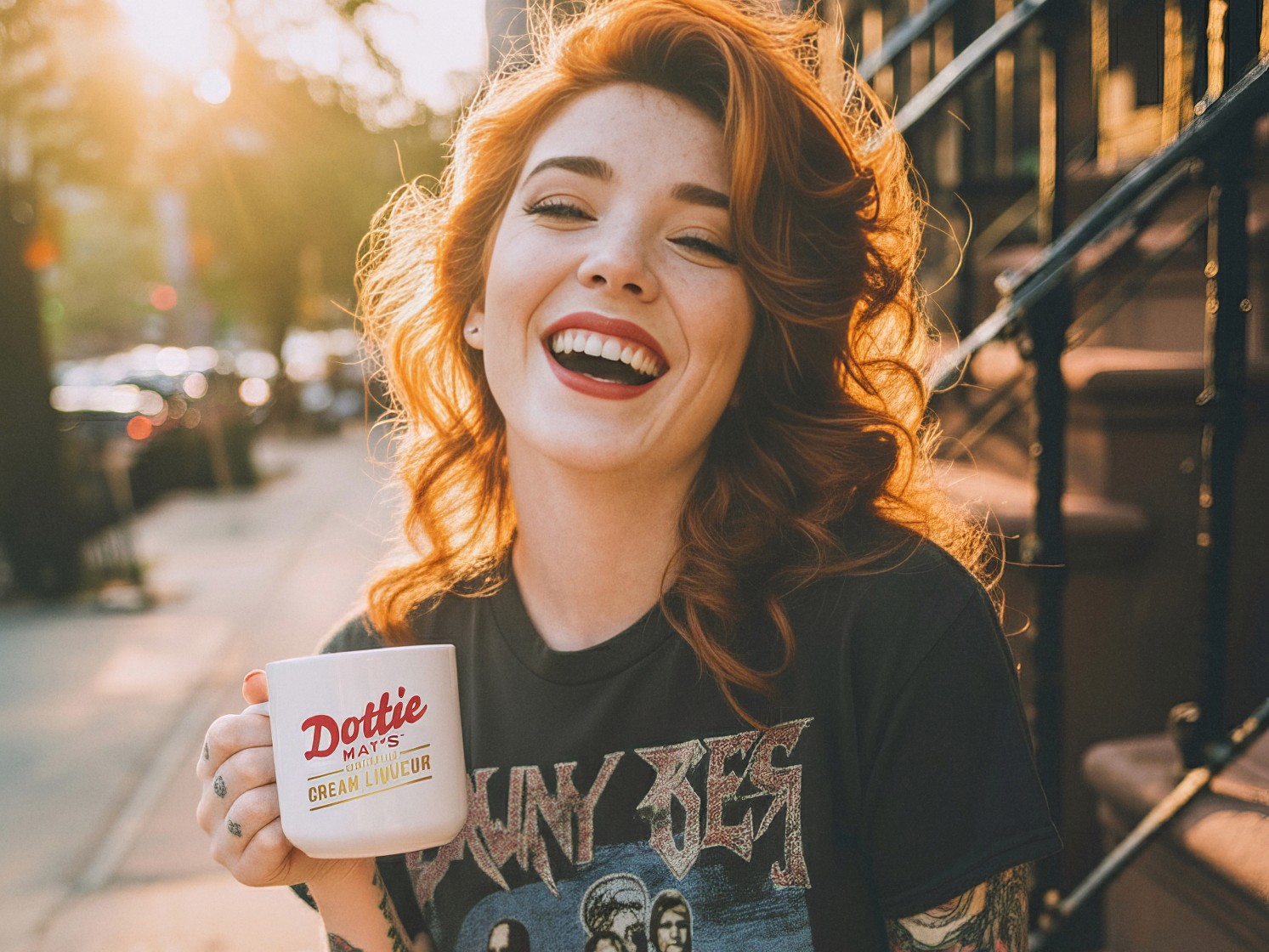
Most brand mascots are stuck as flat logo files, waiting on a production budget to come alive. We took Dottie May’s Oatmilk Cream Liqueur — a static pin-up sketch — and turned her into an animated, music-scored brand ambassador in thirty minutes. Here’s the four-stage process, including the first version that failed, and why testing a character before you fund production rewrites the economics of brand building.
Most brand mascots are powerful marketing tools that never move.
They sit trapped in two-dimensional logo files, waiting on an expensive production budget to bring them to life. What if you could turn a brand character into a dynamic, testable asset instead?
Why most brand mascots stay stuck as static logos
Our test case was the sketched mascot of Dottie May’s Oatmilk Cream Liqueur. She’s a vintage pin-up with signature tattoos and gingham styling, but she existed only as static logo art.
The traditional path to bringing her to life means hiring models, organizing photo shoots, and investing thousands just to test whether a human version resonates with consumers. By the time the results come back, the market opportunity may be gone and the budget spent.
How we turned a static mascot into a living asset
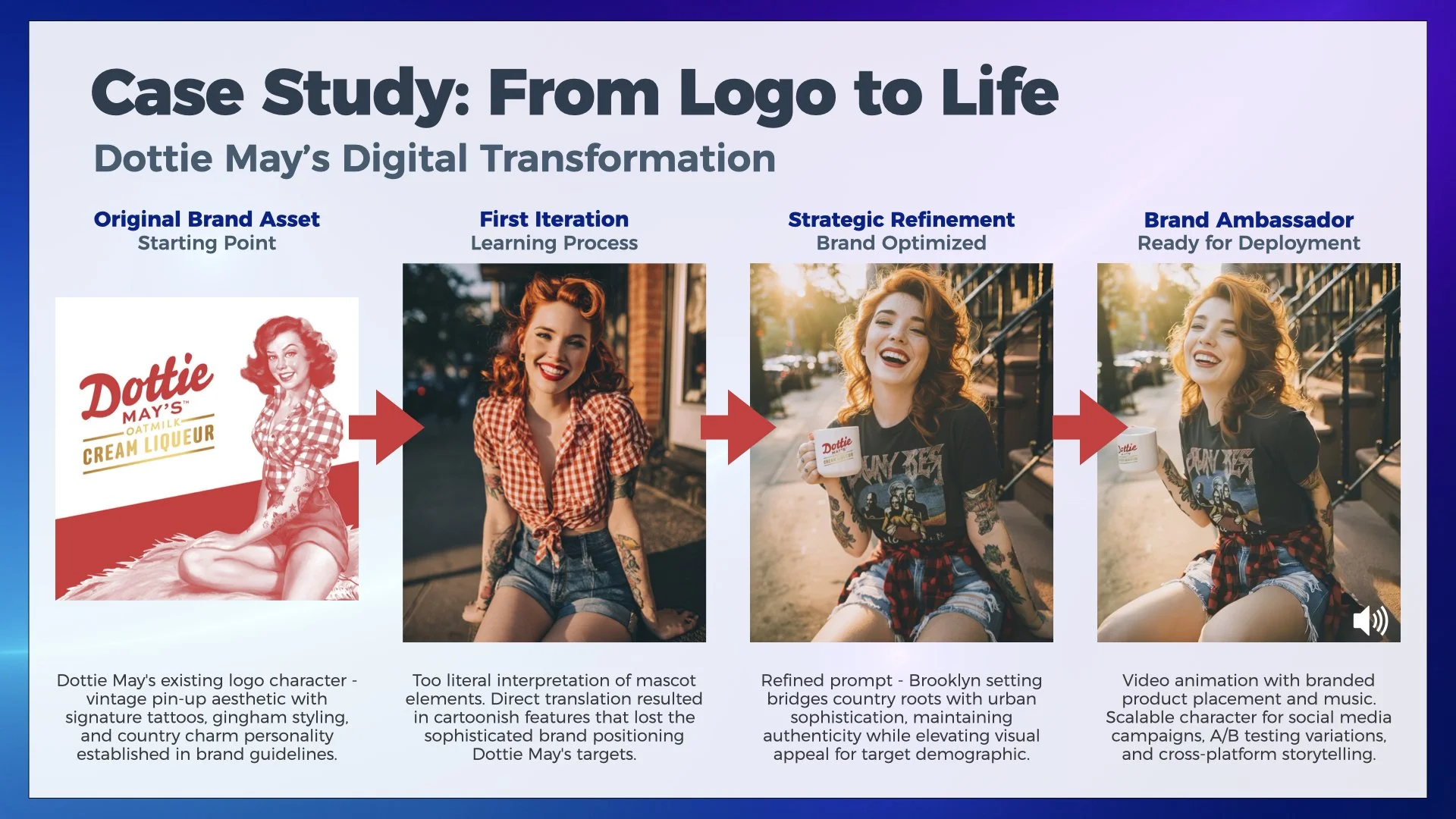
Our process started with brand strategy, not visual replication. Dottie May’s positions itself as bridging “country folk and city slickers,” a sophisticated story that needed nuanced interpretation, not a literal trace.
Stage 1: Strategic foundation
We analyzed Dottie’s existing brand elements: the vintage pin-up aesthetic, the signature tattoos, the gingham styling, and the established personality of country charm with urban sophistication.
Stage 2: Learning from the first failure
Our first AI iteration was too literal. The direct translation came back with cartoonish features that lost the sophisticated positioning Dottie May’s targets. That failure was useful data. It taught us how to refine the approach.
Stage 3: Brand intelligence applied
The breakthrough came when we rebuilt the prompt around strategic positioning rather than appearance. We placed Dottie in a Brooklyn setting that bridges her country roots with urban sophistication, keeping her authentic personality while elevating the visual appeal for the target demographic.
Stage 4: From static to scalable
Within thirty minutes, we had turned a static logo into a living brand ambassador, complete with video animation, branded product placement, and music. The result wasn’t a single asset. It was a scalable character ready for social campaigns, A/B testing, and cross-platform storytelling.
What this unlocks: speed, risk, and scale
This is a fundamental shift in how brands can approach creative development:
Speed to market: Traditional mascot activation takes months and serious budget. This delivers testable assets in minutes.
Risk reduction: Test personality variations before committing to an expensive production campaign. See how consumers respond to different contexts and styling first.
Scalable creativity: Once the character framework exists, infinite variations follow — different settings, seasonal campaigns, product integrations, demographic targeting.
Consumer intelligence: Visual personas give you concrete representations of your target audience, sharpening internal alignment and external briefings.
Who this works for beyond beverage
Dottie May’s is a clean case study, but the capability reaches well past beverage. Any company with a mascot, a brand character, or even an abstract brand personality can use visual persona development:
Emerging brands can validate character appeal before major creative investment.
Established brands can test personality evolution and modernization.
Portfolio companies can hold character consistency across multiple touchpoints.
Investment firms can give stakeholders and potential acquirers a concrete visual representation.
How this flips brand development
Traditional creative development runs a linear, expensive path: concept, then production, then testing, then optimization. This approach flips it: rapid testing, then strategic optimization, then targeted production, then measurable results.
That’s not only efficiency. It’s strategic intelligence. When a brand can visualize and test its personality before committing to full production, every creative decision gets more informed, more targeted, and more effective. The Dottie May transformation shows where AI’s real power sits: not in replacing human creativity, but in amplifying strategic thinking and the rapid iteration that makes great work more accessible, more testable, and more successful.
by // Rachel Ford
(more intel)


